
Therapeutic pipeline

Gene Medicines — Advancing the Next Generation of Non-Viral Curative Therapies

The HPAE platform is being developed to support genetic medicines for rare, untreatable inherited diseases. Our lead programmes focus on a clearly defined molecular target in skin, using two complementary therapeutic directions.

01 — Therapeutic vision

From non-viral delivery to therapeutic possibility

Branca Bunús is developing the HPAE platform as a foundation for genetic medicines. Its modular delivery chemistry is intended to support different therapeutic nucleic acids, cell targets and treatment strategies as research programmes mature.

HPAE-mediated genetic delivery into skin tissue

HPAE-mediated genetic delivery into skin tissue, visually connecting polymer science with therapeutic impact.

01

HPAE non-viral gene delivery platform

02

Defined molecular target

03

Therapeutic genetic cargo

04

Gene medicine development

02 — Therapeutic modalities

One platform, multiple therapeutic directions

The HPAE platform is designed as a flexible delivery system for a range of genetic medicine approaches, including the two lead DEB programmes presented below.

/01

Gene Replacement Therapy

Deliver full-length functional transgenes to restore missing protein expression (BrB202 core programme).

/02

CRISPR Gene Editing

Targeted correction or compensation of disease-causing gene mutations (BrB101 core programme).

/03

mRNA Transient Therapeutics

Temporary protein expression for acute tissue repair applications.

/04

Ex Vivo & In Vivo Cell and Gene Therapy Support

Non-viral delivery chemistry adaptable to both ex vivo and in vivo therapeutic workflows.

/05

Tissue Regenerative Genetic Delivery

Localised genetic cargo delivery supporting tissue repair and regeneration.

/06

Future Emerging Modalities

Continuous platform expansion into new therapeutic categories as R&D programmes mature.

03 — Primary target

Dystrophic Epidermolysis Bullosa

Epidermolysis bullosa is a group of rare inherited skin fragility disorders. Dystrophic epidermolysis bullosa, or DEB, is a major subtype caused by mutations in COL7A1.

What is Epidermolysis Bullosa?

People living with EB have extremely fragile skin and mucosal tissues, where even minor friction or trauma can lead to painful blisters, wounds and scarring. The severity varies widely: some forms mainly affect the hands and feet, while more severe forms can cause chronic wounds, infection risk, nutritional complications, restricted movement, fibrosis and an increased risk of aggressive skin cancer.

Skin fragility

Extremely fragile skin and mucosal tissues can blister after minor friction or trauma.

Chronic wounds

Blisters can lead to open wounds that may take a long time to heal.

Systemic burden

More severe forms can involve infection risk, nutritional complications, restricted movement and fibrosis.

Rare inherited disease

EB is a group of rare inherited skin fragility disorders with a wide range of severity.

Scientific overview: DEB, defective type VII collagen, skin-layer separation, and the RDEB and DDEB forms.

DEB disease mechanism

A medically accurate cross-section of normal skin versus DEB skin, showing defective COL7A1/type VII collagen anchoring fibrils.

Clinical Characteristics

  • Skin fragility manifest; Severe blistering; Scarring; Mitten formation
  • Multiple organs are affected, including skin, oral mucosa, esophageal mucosa, corneas
  • High risk of Squamous Cell Carcinoma
A medically accurate cross-section of normal skin versus DEB skin, showing defective COL7A1/type VII collagen anchoring fibrils.
04 — Understanding DEB

COL7A1, type VII collagen and anchoring fibrils

COL7A1 encodes type VII collagen, a key structural protein that forms anchoring fibrils between the epidermis and dermis. When type VII collagen is missing or defective, the skin layers cannot attach properly, leading to blistering below the basement membrane, repeated wound formation, scarring and progressive tissue damage.

01

COL7A1

→
02

Type VII Collagen

→
03

Anchoring Fibrils

→
04

Dermal–Epidermal Adhesion

COL7A1 mutation

↓

Missing / defective Type VII Collagen

↓

Weak dermal–epidermal attachment

↓

Blistering and repeated wounds

↓

Scarring and progressive tissue damage

Understanding the skin

Epidermis — top layer of skin

Dermis — middle layer

Anchoring fibrils (type VII collagen) — secure the skin layers together

Subcutaneous tissue — deep layer

The role of type VII collagen

Type VII collagen forms anchoring fibrils that act like anchors, keeping the top layer of skin firmly attached to the underlying layers. In DEB, these anchors are defective or missing, causing the skin layers to separate easily and blister.

05 — Inherited forms

RDEB and DDEB: two forms of DEB

DEB is commonly divided into recessive and dominant inherited forms. The document describes differences in the affected skin level, type VII collagen and clinical features.

RDEB

Recessive Dystrophic Epidermolysis Bullosa

Both copies affected

RDEB occurs when both copies of the COL7A1 gene are affected. It is described in the source material as generally more severe, with little or no functional type VII collagen.

  • Blisters form below the top layer of skin, beneath the lamina densa in the upper dermis.
  • Severe blistering can begin from birth, with chronic wounds and scarring.
  • Possible complications may involve internal organs and impact growth and quality of life.
DDEB

Dominant Dystrophic Epidermolysis Bullosa

One copy affected

DDEB occurs when one affected copy of COL7A1 is sufficient to cause disease. It is generally milder than RDEB, with variable severity, and reduced or abnormal but still present type VII collagen.

  • Blisters form within the upper dermis, below the lamina densa.
  • Blistering often starts in childhood or later, with usually milder skin involvement.
  • Mucosal involvement is common, with a wide range of severity.
06 — Scientific rationale

Why Gene Therapy for DEB?

DEB has a clearly defined molecular cause related to defective or insufficient type VII collagen. This makes it an important candidate for genetic medicine. A successful therapeutic strategy could aim to restore collagen expression and improve skin stability.

Why DEB is suited to genetic medicine

  • Clearly defined single-gene cause
  • Known therapeutic target: type VII collagen
  • Skin is accessible for local treatment and monitoring
  • Restoring collagen could directly improve skin stability

What a successful therapy could aim to do

1

Restore type VII collagen expression

2

Improve dermal–epidermal adhesion

3

Support wound closure

4

Reduce repeated cycles of injury and scarring

5

Improve long-term skin stability

The goal described in the source material is healthier skin with fewer wounds, less scarring and improved quality of life.

Scientific overview: why DEB is suited to genetic medicine, potential therapeutic aims, and the rationale for non-viral delivery.
07 — HPAE delivery platform

Branca Bunús’ Non-Viral Delivery Solution

Branca Bunús is developing a non-viral gene delivery platform based on advanced polymeric nanoparticles. The technology is designed to package and deliver therapeutic nucleic acids into skin-relevant cells, including keratinocytes and fibroblasts.

Designed for flexibility in DEB

Unlike viral vectors, non-viral delivery systems may offer advantages in payload flexibility, repeat administration potential, scalable manufacturing and modular formulation design. These features are particularly relevant where therapeutic strategies may require large genetic payloads, local skin delivery and repeated treatment of chronic or recurrent wounds.

Payload flexibility
Repeat administration potential
Scalable manufacturing
Modular formulation design
Large genetic payload compatibility
Local skin delivery
Potential application to chronic or recurrent wounds

Platform architecture

HPAE Non-Viral Gene Delivery Platform
↓
Dystrophic Epidermolysis Bullosa
↓
BrB101 — Gene Editing
↓
BrB202 — Gene Replacement
08–09 — Lead programmes

Two Complementary Therapeutic Directions

BrB101 and BrB202 address the same therapeutic target through two different genetic medicine strategies. Both programmes are being developed on Branca Bunús’ HPAE non-viral delivery platform.

BrB101

Gene Editing

EMA Orphan Drug Designation

Gene editing aims to correct or compensate for disease-causing mutations at the genetic level. A gene editing strategy could offer a more durable correction in treated cells, especially if editing can be achieved in regenerative skin cell populations.

Disease-causing mutation→Gene editing→Genetic correction / compensation

Mechanism

HPAE + Cas9/sgRNA RNP → skin-cell uptake → targeted COL7A1 exon deletion/editing → restored functional expression.

BrB101: HPAE + Cas9/sgRNA RNP → skin-cell uptake → targeted COL7A1 exon deletion/editing → restored functional expression.
BrB101 conceptual pathway: HPAE polymer and CRISPR/Cas9 RNP complex formation, delivery and exon deletion strategy.
BrB202

Gene Replacement

EMA Orphan Drug Designation

Gene replacement aims to provide cells with a functional version of the COL7A1 genetic instruction, enabling them to produce type VII collagen. The HPAE platform is being designed to deliver large DNA-based payloads and support local expression of therapeutic proteins in skin tissue.

Functional COL7A1 genetic instruction→Cellular delivery→Type VII collagen production

Mechanism

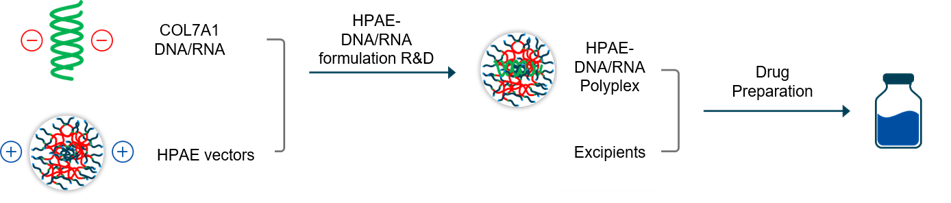
HPAE + full-length COL7A1 plasmid → delivery into dermal/epidermal cells → type VII collagen expression → restoration of anchoring fibrils.

Plasmid with independent intellectual property rights
(Encoding human full-length type VII collagen gene)

BrB202: HPAE + full-length COL7A1 plasmid → delivery into dermal/epidermal cells → type VII collagen expression → restoration of anchoring fibrils.
BrB202 conceptual pathway: HPAE polymer and full-length COL7A1 plasmid polyplex formation, delivery and gene replacement strategy.
Two complementary strategies. One therapeutic target.
10 — Beyond rare skin disorders

Modular architecture, expanding therapeutic reach

While DEB is the flagship translational pipeline asset, the modular HPAE architecture supports broad expansion across oncology, regenerative medicine and immune genetic therapies as R&D programmes mature.

11 — Partnership opportunities

Co-develop HPAE-enabled therapeutic programmes

Branca Bunús actively seeks pharma, biotech and academic clinical partners to co-develop HPAE-enabled gene therapy programmes across therapeutic categories. We offer flexible platform licensing, joint development and pre-clinical collaboration frameworks for aligned strategic partners.

Explore Therapeutic Partnership Opportunities